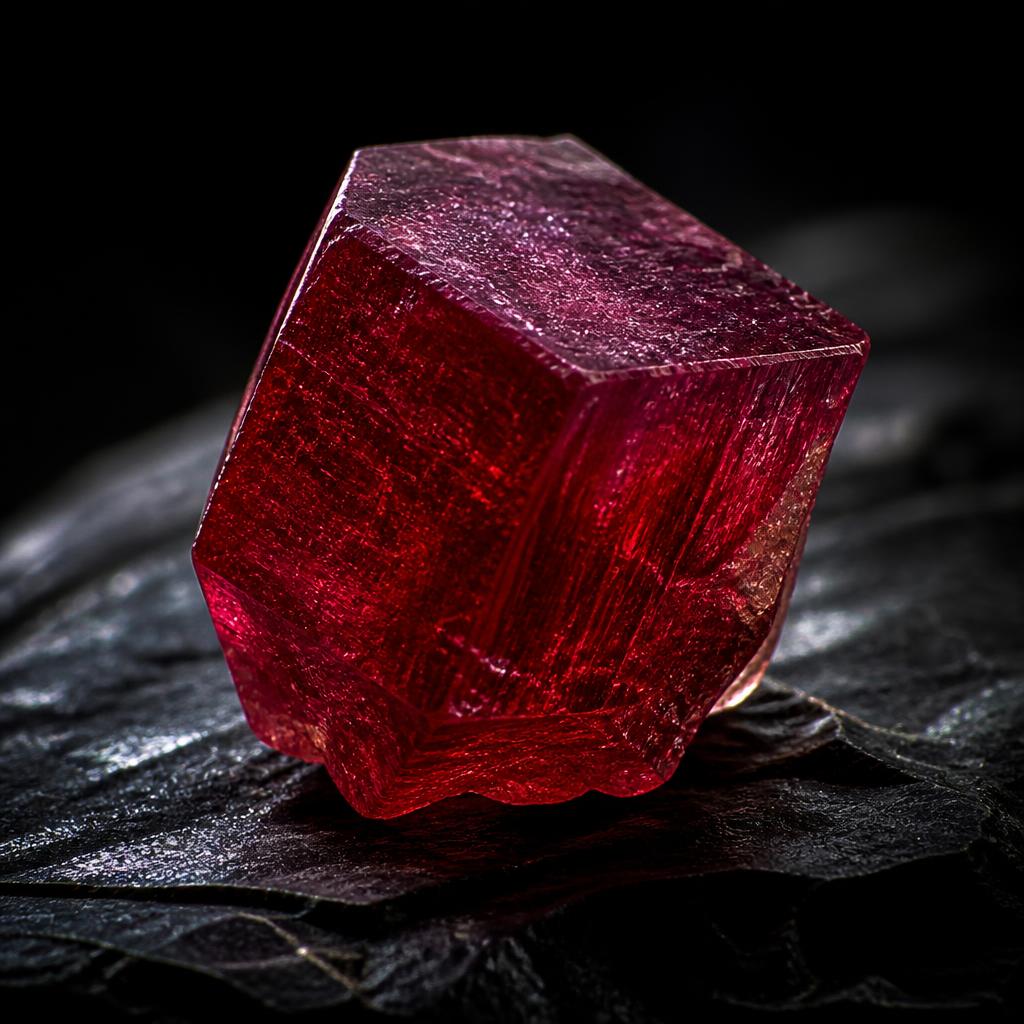
The Jewel of the Day
Ruby
The chosen stone — the same crystal as sapphire, elected into red by a trace of chromium; the choicest of the corundum, king of gems, the first article every other stone is compared to.
Carries the Law of the Prototype
- Family
- Corundum (Al₂O₃) — the identical mineral as sapphire, turned red by chromium
- Hardness
- 9 on the Mohs scale — only diamond is harder
- Colour
- From cherry to the fabled 'pigeon's blood' — pure red with a whisper of blue
- Signature
- Fluorescence: chromium makes a fine ruby glow red under sunlight, lit from inside
- Found in
- Myanmar (Mogok), Mozambique, Madagascar, Thailand, Sri Lanka, Greenland
- Carried for
- Ownership, courage, vitality, chosenness, authority, the confidence of the first article
How the stone came to be
A ruby is a sapphire that was chosen differently. Same mineral, same hexagonal lattice, same hardness of nine — the only difference is which trace element sat down in the aluminium's seat. Iron and titanium make blue. Chromium makes red. Day One drew the plan; Day Two shows what one deliberate substitution does to the whole colour of a thing.
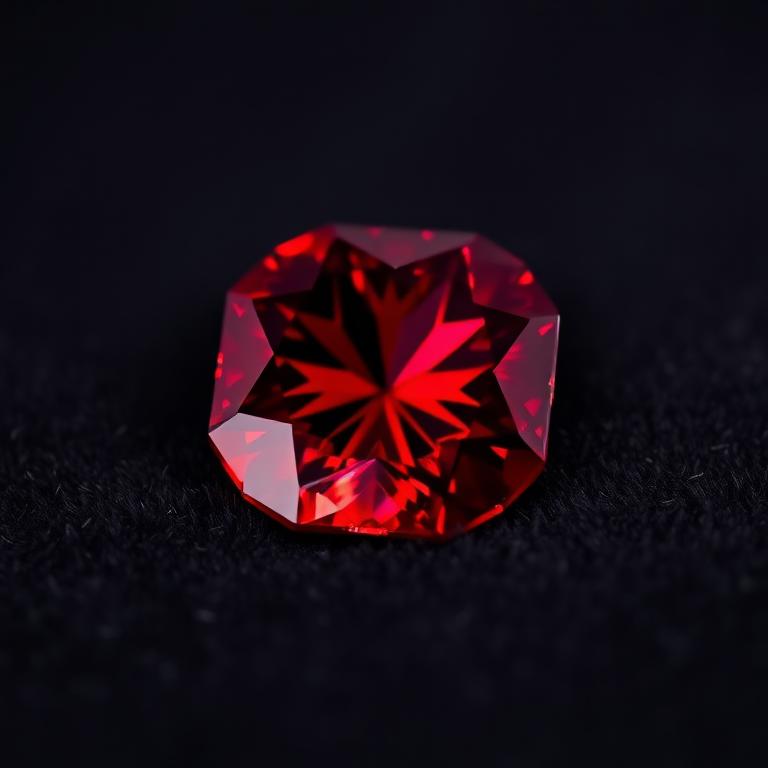
Chromium does something else, too: it fluoresces. In sunlight a fine Burmese ruby glows, red light coming back out of the stone stronger than the light that went in. It does not merely reflect its setting — it adds to it. That is the complimentary nature: it raises the level of whatever room it is carried into.
Chromium is also why rubies are rare and almost always flawed. The same atom that gives the colour strains the lattice as it grows, so most rough cracks before it gets large. A clean ruby over a few carats is scarcer than a comparable diamond — the very thing that makes it choicest is the thing that makes it hard to make. Prototypes are like this: the first article carries the strain of being first.
For three thousand years it has been the stone of ownership and rank — ratnaraj in Sanskrit, 'king of precious stones', set in crowns and signets, worn over the heart, given as proof of title. It is the gem of the chosen: the one held up and compared against, the model of what red should be.
What it is carried for
- Carried as the stone of ownership and command — worn by those who hold title.
- The traditional jewel of courage and vitality: it is said to keep the blood and the will moving.
- Held for chosenness — worn when a woman, a work or an offer is being selected.
- Kept to end passivity: the stone of cause rather than effect.
- Given as a token of devotion and value, the price of a good woman being 'above rubies'.
As you live this law, you become this stone
The jewel is not a souvenir. Every element of Ruby is an element you gain as you walk the Law of the Prototype \u2014 not by admiring the stone, but by living it until you are made of the same thing.
You gain \u00b7 Same lattice, chosen colour
Ruby and sapphire differ by one trace element. She is not rebuilt to be chosen — one deliberate substitution changes the whole colour.
You gain \u00b7 It glows in the light
Chromium fluoresces: the stone gives back more red than it received. Complimentary by nature — she adds to the room.
You gain \u00b7 The strain of being first
What makes ruby choicest also makes it flawed and rare. A prototype is allowed to carry the marks of being the first one made.
You gain \u00b7 King of gems
The stone others are compared to. Once the first article exists, everything after it is cut to that pattern.
You gain \u00b7 Worn as title
Set in crowns and signets as proof of ownership. Ownership already exists — the ruby only says so out loud.
A jewel fit for a king — and a queen
Smile when you read this, because it is about you. A rough stone is not set in a crown; a cut one is. As you become and develop through this program you are being cut, warmed and polished into a jewel fit for a king and for a queen — and the joy of it is that you get to enjoy the stone you are turning into.
And you become your business. What you are made of shows up in your pricing, your rooms, your table, your people and your work. She does not have a brand — she has a nature, and everything she touches reflects it.