The Jewel of the Day
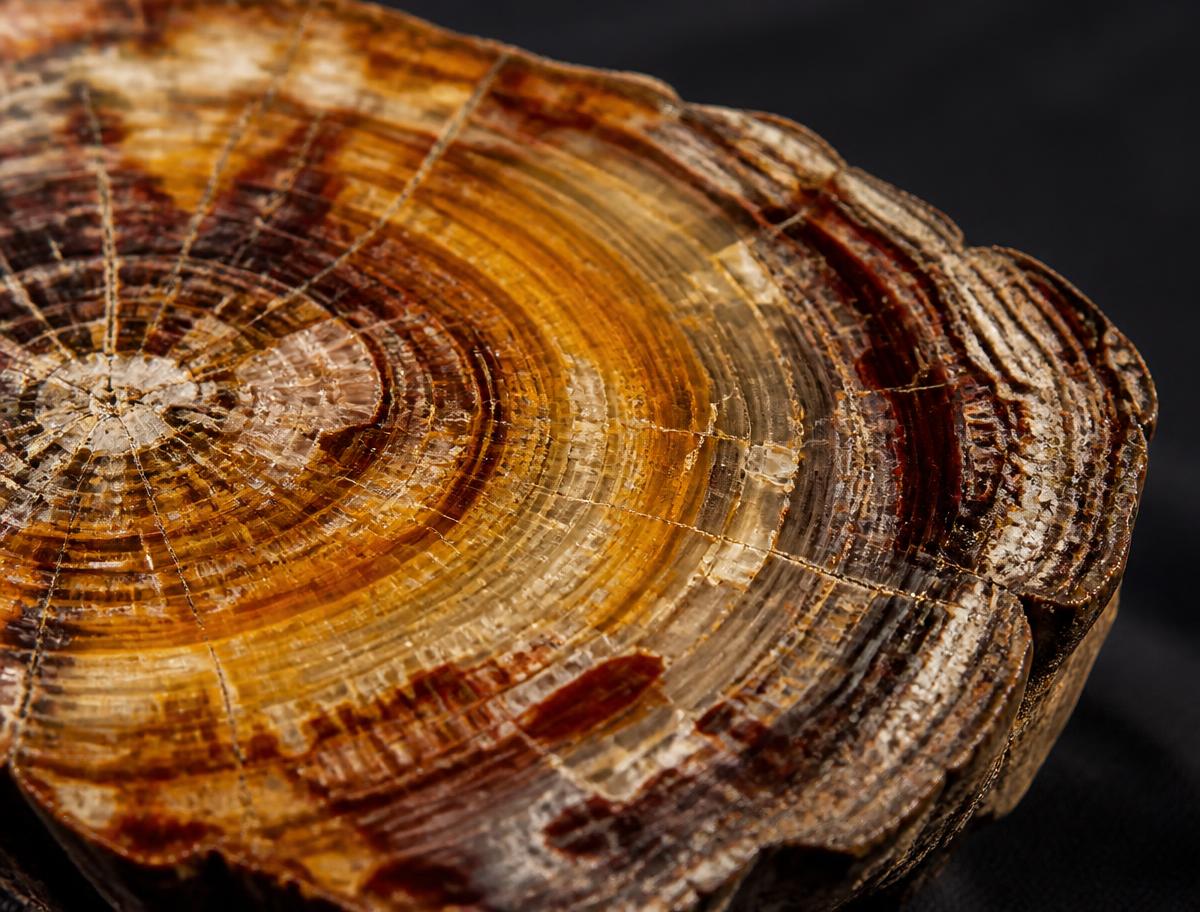
Petrified Wood
The preserving stone — a tree that endured so completely it became quartz, keeping every ring, every cell and every year it ever obtained.
Carries the Law of the Procurement
- Family
- Fossilised wood · chalcedony and quartz (SiO₂) replacing organic cell walls
- Hardness
- 6.5–7 on the Mohs scale — the softness of wood traded for the hardness of quartz
- Colour
- Amber, honey, oxblood, cream and black — iron, manganese and carbon in the groundwater
- Signature
- Growth rings, bark and cell structure preserved cell-for-cell in stone
- Found in
- Arizona's Petrified Forest, Madagascar, Indonesia, Argentina, Namibia
- Carried for
- Endurance, patience, preservation, long money, ancestral memory, keeping what is obtained
How the stone came to be
Petrified wood is the record of a tree that got buried before it could rot. Sediment or volcanic ash sealed it away from oxygen, and mineral-rich water moved through it for millions of years, depositing silica inside each cell wall — molecule for molecule — until the wood was gone and the shape of the wood remained. Nothing was lost in the exchange except softness. The rings are still countable. The bark is still bark.
This is why it is the stone of procurement rather than the stone of luck. A tree obtains slowly: one ring a year, water and light and mineral, evenly, without a season of brilliance. Petrified wood is that consistency made permanent — every good year and every hard year still visible in the slab, and the hard years are usually the thin dark lines that hold the whole pattern together.
Its colours are a ledger of what the water carried: iron for the reds and ambers, manganese for the pinks and purples, carbon for the black. The stone did not choose them; it simply kept whatever came through and made it part of itself.
Whole forests of it lie in Arizona, logs two hundred million years old lying where rivers dropped them. Craftsmen have cut it into tables, floors and altar tops for centuries — a material chosen precisely because it will still be there.
What it is carried for
- The traditional stone of endurance — carried for the long middle of a thing, when constancy is the only work available.
- Called the stone of preservation: held by women building what is meant to outlive them.
- Worn for patience with slow increase — one ring a year, obtained and kept.
- Kept as the stone of ancestral memory and inheritance: a record that survived the body it grew in.
- Used for grounding and steadiness, and to settle a house that has been running hot and cold.
As you live this law, you become this stone
The jewel is not a souvenir. Every element of Petrified Wood is an element you gain as you walk the Law of the Procurement \u2014 not by admiring the stone, but by living it until you are made of the same thing.
You gain \u00b7 It kept its rings
Every year is still countable in the stone. Procurement is a record, not a moment.
You gain \u00b7 Cell for cell
Silica replaced the wood without losing the shape. She endures by exchange, not by collapse.
You gain \u00b7 Buried, not lost
It survived because it was sealed away from the air. Some obtainments are kept by being hidden for a season.
You gain \u00b7 Harder than the tree
It ends at quartz hardness. Enduring is what makes a soft thing permanent.
You gain \u00b7 It holds together
Cohesive all the way through — which is why you can cut it into a table and stand it in a house.
A jewel fit for a king — and a queen
Smile when you read this, because it is about you. A rough stone is not set in a crown; a cut one is. As you become and develop through this program you are being cut, warmed and polished into a jewel fit for a king and for a queen — and the joy of it is that you get to enjoy the stone you are turning into.
And you become your business. What you are made of shows up in your pricing, your rooms, your table, your people and your work. She does not have a brand — she has a nature, and everything she touches reflects it.