The Jewel of the Day
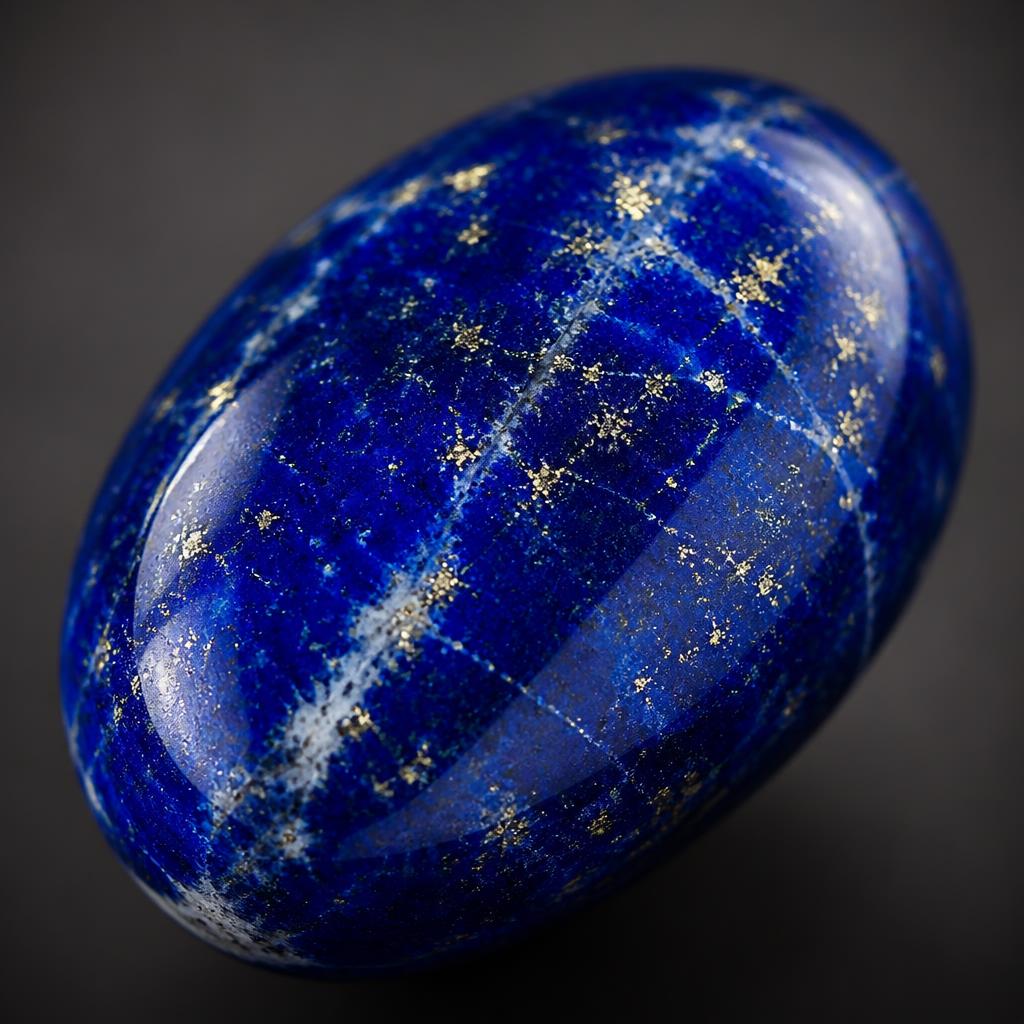
Lapis Lazuli
The patron's stone — rough rock from a rough country, ground into the blue that every masterpiece had to be paid for in.
Carries the Law of the Patronage
- Family
- A rock, not a mineral — lazurite with pyrite and calcite
- Hardness
- 5–6 on the Mohs scale
- Colour
- Deep royal ultramarine, flecked gold and veined white
- Signature
- Golden pyrite — the other metal living inside the blue
- Found in
- Sar-e-Sang, Afghanistan (6,000 years); Chile, Russia, Pakistan
- Carried for
- Friendship, truth, honour, patronage, spoken good
How the stone came to be
Lapis lazuli is not one mineral. It is a rock — blue lazurite crowded with brassy pyrite and threaded with white calcite, three rough materials pressed into one body. Nothing about the raw block is refined. The finest of it has been cut out of the Sar-e-Sang mines in the Hindu Kush for some six thousand years, hauled by donkey out of a hard, cold, mountain culture long before it ever reached a court.
Out of that rough came the rough of the rough. Ground and purified, lapis becomes ultramarine — ‘beyond the sea’ — the most expensive pigment in the history of painting, dearer by weight than gold. A Renaissance patron did not commission a Madonna and hope for blue; the contract named the ultramarine and named who paid for it. The colour on the panel was somebody's outlay.
It was also the stone of the first great exchanges: Egyptian scarabs and Tutankhamun's inlays, Sumerian seals at Ur, Cleopatra's eye paint, and trade routes running thousands of miles because two peoples who had nothing else in common both wanted this blue. Lapis is the record of what one hand laid out so another hand could make something that outlived them both.
What it is carried for
- The ancient stone of friendship and truth — carried for honest speech between two parties.
- Held for honour and dignity in dealing: the stone of the person who keeps their side of the coin.
- Traditionally worn by royalty and their patrons, for favour and for good standing with others.
- Carried to open warmth without losing judgement — cordial, not careless.
- Used for generous spending of self: attention, backing, and the word given on another's behalf.
As you live this law, you become this stone
The jewel is not a souvenir. Every element of Lapis Lazuli is an element you gain as you walk the Law of the Patronage \u2014 not by admiring the stone, but by living it until you are made of the same thing.
You gain \u00b7 Gold inside the blue
Pyrite is a different substance entirely and lapis is prized for it. Being the other is not a flaw in the stone — it is what makes it worth setting.
You gain \u00b7 Three rough things, one body
Lazurite, pyrite, calcite. Congenial means of the same kind, and lapis proves a kind can be made of unlike materials that hold together.
You gain \u00b7 It becomes the pigment
The stone gives itself up to be ground and every painting is enhanced by it. Enhance is her verb: nothing leaves her hands the same size.
You gain \u00b7 Someone always paid for the blue
Ultramarine was named in the contract. Patronage is not sentiment — it is outlay, and the masterpiece is the receipt.
A jewel fit for a king — and a queen
Smile when you read this, because it is about you. A rough stone is not set in a crown; a cut one is. As you become and develop through this program you are being cut, warmed and polished into a jewel fit for a king and for a queen — and the joy of it is that you get to enjoy the stone you are turning into.
And you become your business. What you are made of shows up in your pricing, your rooms, your table, your people and your work. She does not have a brand — she has a nature, and everything she touches reflects it.